
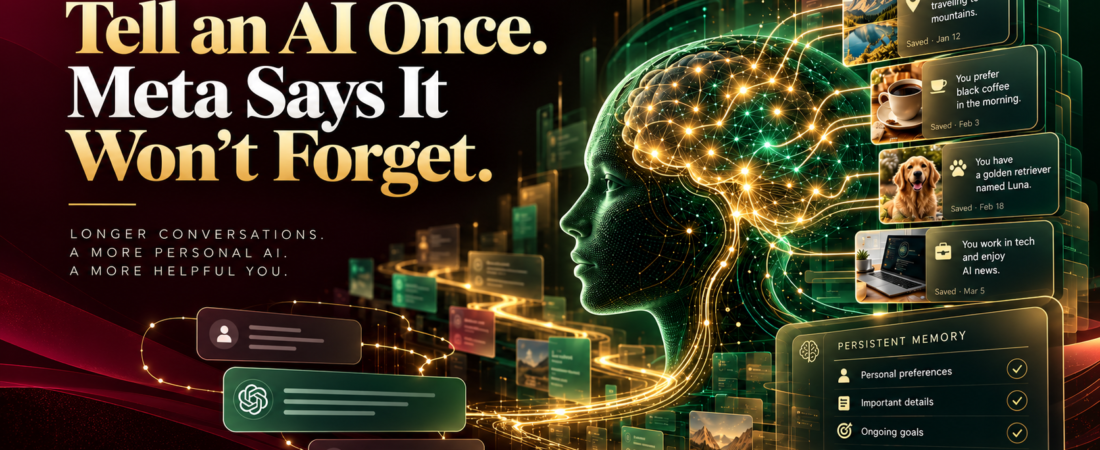
Most AI chats start from zero. You explain what you need, get help, and next time you start over. Meta says its newest AI models are designed to work differently.
The news
On October 12, 2026, Meta announced two AI models: Muse Wonder and Muse Wonder Full. Meta calls them the most capable models it has built so far. It says they are made for personal and professional tasks that an AI agent carries out on your behalf, and that they are strong in areas like law, finance, health and coding.
Axios reports that this launch is part of Meta’s effort to catch up with OpenAI, Anthropic and Google, and calls it an important test of Meta’s investment in AI.
Meta’s two named features
Meta gave names to two abilities:
- Active Memory. The AI is meant to carry what matters to you from one conversation to the next, and bring back the relevant details for the task in front of it.
- Active Focus. The AI is meant to keep working toward your goal when a task gets hard. Meta says it can try other approaches and recover from errors, and that it asks for clarification when needed and checks in before doing anything important.
Who can use them right now
Muse Wonder is available today to developers through the Meta Model API and Muse Code. Muse Wonder Full is available today to Muse Code subscribers.
Meta says Muse Wonder will soon power more of its Muse assistant, and that paying subscribers will get it first.
What Meta says about safety
Meta says it trained the models to avoid sharing private information without permission, to turn down requests to help with harmful acts, and to help strengthen defenses against cyber attacks. It also says developers and security teams can use the models to find flaws in their own code.
Meta says a full report with more safety testing will be available soon. Axios adds that a shorter model card was due on the day of the announcement.
What the early reporting says about performance
Axios reports that Meta posted benchmark scores showing the models topping or matching the latest offerings from OpenAI and Anthropic. These are Meta’s own results. Axios says the thing to watch is whether the claimed advantages hold up in independent testing, and how quickly the technology reaches the people who use Meta’s apps.
The privacy question
Axios also gives a “reality check.” AI agents that remember personal information and act for a user bring new privacy and security challenges.
Meta says it has strengthened protections for personal information. Still, an AI that keeps details about you means there is more information to protect.
My take: what this could mean for creators and small business owners
This section is my opinion, not reporting from Meta or Axios.
If you run a small business or create content, the idea of an AI that remembers your preferences is appealing. It could mean less time repeating the same instructions. Meta hasn’t said these models do anything like that for creators, so think of this as something to watch, not something to expect.
Whether tools like this are worth using will depend on what you’re comfortable sharing, and on how well they work in everyday use. That isn’t proven yet.
Your turn
Would you use an AI that remembers you? Tell me in the comments.
Sources: Meta Newsroom and Axios